Part 1-I Wrote A Novel! Now What?
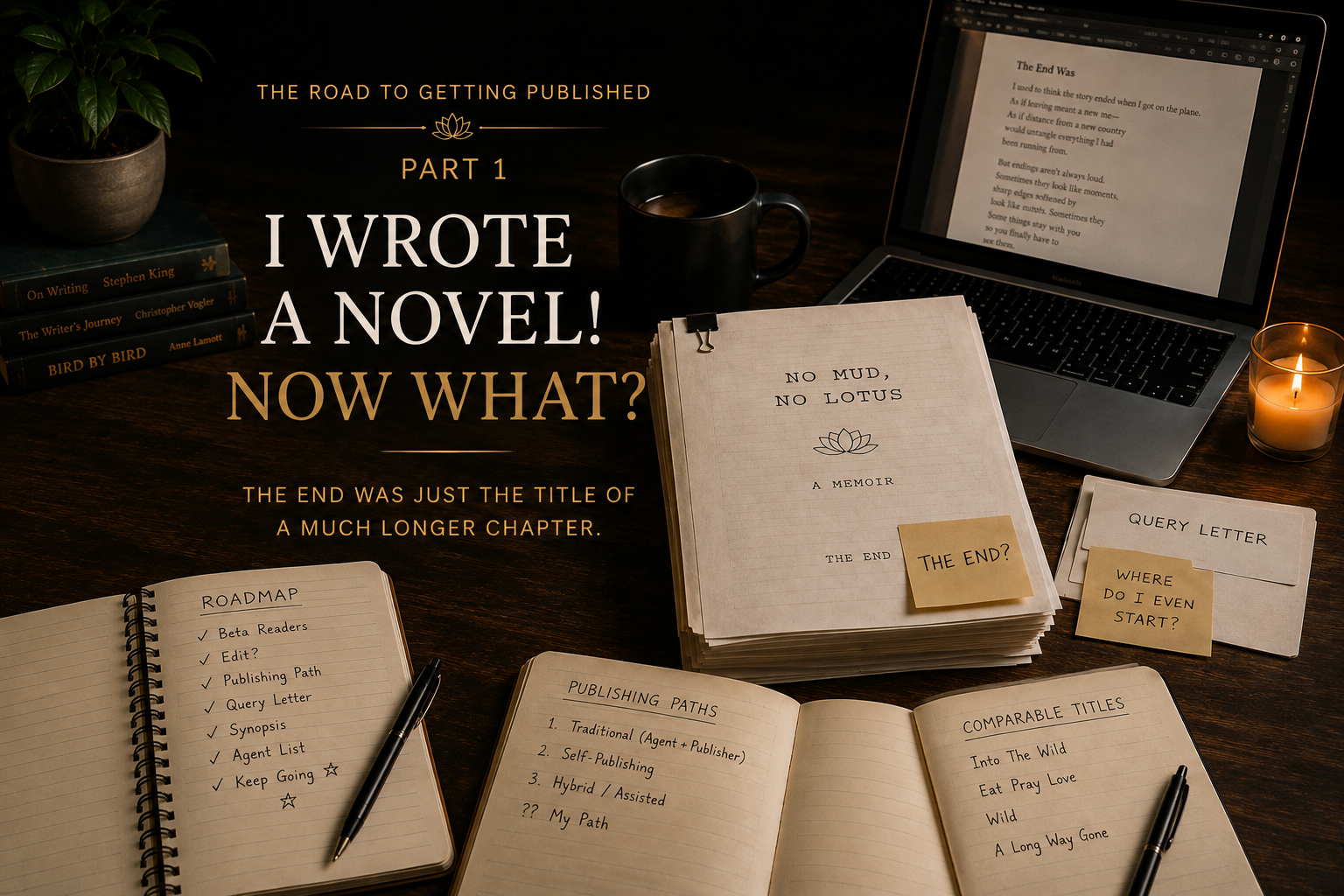
Turns out "The End" was just the title of a much longer chapter.
I finished the manuscript on a random Tuesday. No fireworks, no champagne — just me, closing the laptop, sitting there for a second waiting to feel like a Real Author.
I did not feel like a Real Author.
I felt like someone who had just built an entire house and only then remembered that houses need plumbing, electricity, a roof that doesn't leak, and a person willing to actually buy it.
Turns out "I finished my book" is not a destination. It's a starting line disguised as a finish line. Nobody warns you about this. Every movie about writers ends the second the manuscript is done — triumphant music, maybe a montage of rejection letters that magically resolve into a book deal two scenes later. Nobody shows you the part where you sit there afterward going: okay, but what do I actually DO now?
So here's what I've learned "now what" actually means, roughly in the order it hit me:
Road One: Get it in front of readers before anyone else. Turns out you're the worst possible judge of your own book — you've read it so many times you can't tell anymore if the middle drags or if you've just gone numb to it. So you find real humans willing to read the whole thing and tell you the truth, which is a genuinely vulnerable thing to ask for, and also occasionally results in someone quoting your own sentence back to you, which might be the single best feeling in this entire process so far.
Road Two: Figure out if it needs professional help, or if you're just scared. (More on this one next time — turns out those are two different questions, and only one of them costs money.)
Road Three: Decide how you're actually trying to get this thing published. This is where it gets genuinely overwhelming, because it turns out "publish a book" isn't one path, it's at least three: find a literary agent who takes you on and sells the book to a traditional publisher; skip the agent and publisher entirely and self-publish it yourself; or some hybrid version where you pay a company to handle the production side while you keep more control. Nobody tells you upfront that you have to pick a lane before you even fully understand what's in each lane.
Road Four: Build the actual submission materials, which — plot twist — is basically writing several entirely new, much shorter documents about the book you just spent years writing. A query letter. A synopsis. A pitch you can say out loud in one breath at a party without losing the room. Comparable titles, which means reading about other books instead of writing your own, which feels like procrastination and also is somehow required.
Road Five: The actual list. I made the mistake, somewhere in week two of all this, of writing down everything I apparently needed to do. It filled an entire page. Then it filled a second page. At one point I had a genuine, unironic to-do list with more items on it than my actual manuscript has chapters, which felt like the universe making a point I didn't ask for.
I'm not going to pretend I've got this all figured out. I very much do not. What I've landed on, for now, is picking the next single thing instead of staring at the whole mountain — because staring at the whole mountain mostly just makes you want to go lie down.
So that's the honest answer to "now what." You don't do all of it. You just do the next thing. Then the thing after that.
I'll be writing about each of these roads as I actually walk them — what worked, what didn't, and probably a few things I got wrong the first time and had to redo. Follow along. I promise it's more interesting than it sounds, and considerably less put-together than it looks from the outside.