Do First-Time Authors Really Need to Pay for a Developmental Editor?
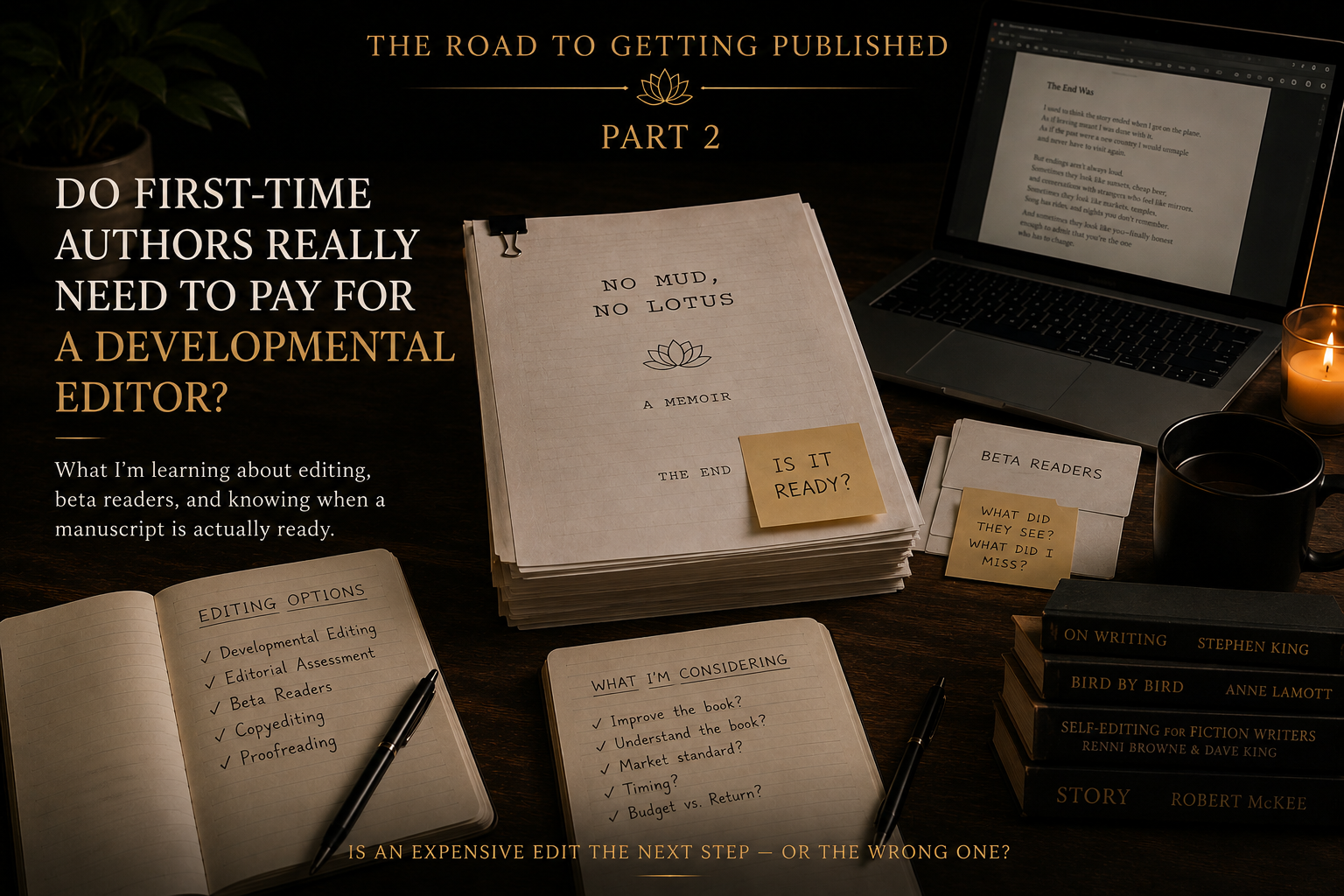
What I'm learning about editing, beta readers, and knowing when a manuscript is actually ready.
When I finished writing my first book, I thought the hardest part was over.
I was wrong.
The manuscript is an 80,000-word travel memoir. I've revised it three times, lived with the story for years, and spent more time than I care to admit moving paragraphs around, questioning chapters, and wondering whether something that made perfect sense to me would make any sense to anyone else.
For a while, I felt pretty good about it.
Then I started learning more about publishing.
That's when the questions started.
Do I need a developmental editor?
Should I spend several thousand dollars having someone go through the manuscript?
Is the book actually ready?
And perhaps the question that stopped me in my tracks:
If I want to traditionally publish this book, why should I pay for editing that a publisher may eventually provide?
I don't think there's an easy answer.
But I'm starting to think there may be a better question to ask.
What does the book actually need right now?
The Advice Can Get Overwhelming
Once you tell people you've written a book, you quickly discover that there is an entire industry built around helping you finish it.
Developmental editors.
Copyeditors.
Proofreaders.
Book coaches.
Query coaches.
Writing consultants.
Publicists.
And plenty of people offering to help you navigate the publishing process.
Many of these people provide valuable services.
But as a first-time author, it's surprisingly easy to start believing that you need to purchase all of them before you're allowed to call your manuscript finished.
I'm not sure that's true.
In fact, if you're pursuing traditional publishing, I think it's worth slowing down before spending thousands of dollars simply because you're afraid your manuscript isn't good enough.
That fear is real.
Especially when you've spent years writing something deeply personal.
At some point, you have to distinguish between making the book better and paying someone because you're afraid it isn't good enough yet.
Those aren't necessarily the same thing.
So What Does a Developmental Editor Actually Do?
A developmental editor looks at the big picture.
They're not primarily looking for commas or spelling mistakes. They're looking at the architecture of the story.
Does the structure work?
Does the pacing hold?
Does the middle sag?
Are the important moments getting enough space?
Does the ending deliver the emotional payoff the story has been building toward?
And with memoir, there's another question that may be even more important:
What is this book really about?
That's particularly important with travel memoir.
Because a travel memoir can't simply be a list of places you've visited and interesting things that happened along the way.
The travel is the setting.
The deeper story is usually the journey happening inside the person telling it.
What changed?
What did you lose?
What did you discover?
What did you understand differently when you finally came home?
Those are the questions that can turn a collection of experiences into a memoir.
And they're questions I've had to ask myself repeatedly while writing No Mud, No Lotus.
So Why Pay for an Editor If a Publisher Will Edit It?
This was the part I kept coming back to.
If I pursue traditional publishing, I'll first need to get the manuscript in front of literary agents.
If an agent eventually represents the book and a publisher acquires it, there will be an editorial process.
So why spend several thousand dollars doing extensive editorial work before I've even reached that point?
I don't think the answer is simply don't hire an editor.
A good developmental editor can absolutely make a manuscript stronger.
But I also don't think every first-time author needs one before querying.
There's an important distinction between:
"This manuscript could still be improved."
and
"This manuscript has structural problems that I can't solve on my own."
Every book can probably be improved.
That doesn't mean every book needs another expensive round of professional editing.
That's Where Beta Readers Come In
Before spending money on another professional opinion, I'm doing something much simpler.
I'm letting ten other people read the manuscript.
These aren't editors.
They're readers.
And that's exactly why I'm interested in what they have to say.
I've revised the book three times. At this point, I'm too close to it to experience it the way a new reader will.
I need people who can tell me:
Where did you get bored?
Where were you confused?
Which parts stayed with you?
Did you care about the people in the story?
Did the ending work?
And perhaps most importantly:
What do you think this book is actually about?
That last question could be incredibly revealing.
Because I know what I think the book is about.
But that isn't necessarily what a reader will find.
Not All Feedback Is Equal
One thing I'm learning is that getting feedback doesn't mean you have to accept every suggestion.
If one person doesn't like a chapter, that doesn't necessarily mean the chapter needs to disappear.
Readers have different tastes.
But if six out of ten people independently tell you that the middle drags, that's different.
Patterns matter.
I'm going to look for those patterns rather than trying to satisfy every individual opinion.
Otherwise, you can revise a book into oblivion.
There's another danger, too.
Sometimes writers start changing the book every time someone reacts differently than they expected.
Eventually, the story stops sounding like the writer.
I don't want that either.
The goal isn't to make everyone happy.
The goal is to understand what the reader is experiencing—and then decide what, if anything, needs to change.
Maybe the Next Step Isn't Another Editor
This may be the most reassuring thing I've learned so far.
As a first-time author, it's easy to believe there's always something else you should do before you're allowed to move forward.
Another revision.
Another consultant.
Another course.
Another professional opinion.
Another expense.
At some point, though, you have to make a decision.
Is the manuscript ready to put in front of literary agents?
Or does it genuinely have a structural problem that requires professional help?
If my beta readers reveal major problems with the narrative arc, pacing, or overall structure, I may decide that a developmental editor is worth the investment.
But I don't need to make that decision before I hear what they have to say.
An Editorial Assessment Might Be the Middle Ground
If I decide I need professional help, I also don't necessarily have to jump straight into a full developmental edit.
An editorial assessment is another possibility.
Instead of having an editor work extensively through the entire manuscript, I could have someone read the book and provide a detailed report outlining its strengths, weaknesses, and recommended revisions.
That could give me something incredibly useful:
a clearer understanding of what I need to fix.
And if the assessment says the manuscript is structurally strong?
That's valuable information too.
Traditional Publishing Changes the Equation
The answer also depends on the publishing path.
If I pursue traditional publishing, I'll need to get the manuscript in front of literary agents. If an agent takes me on and eventually sells the book, the publisher will have its own editorial process.
If I choose self-publishing, I'm effectively taking on the role of the publisher.
That makes professional editing much more important because there isn't a publishing house waiting on the other side to provide that editorial process.
So maybe the question isn't:
"Do writers need editors?"
Of course they do.
Maybe the better question is:
"At what stage does this particular writer need this particular kind of editing?"
That's the question I'm trying to answer for myself.
What I'm Doing Next
For now, I'm waiting.
Ten beta readers are reading the manuscript.
I'm going to listen carefully to what they tell me.
I'll look for patterns rather than trying to respond to every individual opinion.
Then I'll revise the manuscript again if necessary.
After that, I'll make a decision.
Maybe I'll decide the book is ready to query.
Maybe I'll decide it needs another serious developmental pass.
Maybe I'll pay for an editorial assessment.
Maybe I'll decide I don't need any of those things right now.
I don't know yet.
And I'm starting to think that's okay.
What I've Learned as a First-Time Author
The biggest lesson I'm taking away so far is surprisingly simple:
You don't have to buy your way into being a published author.
Professional editors can be wonderful. I'm certainly not opposed to hiring one.
But when you're writing your first book, it's easy to become overwhelmed by all the services you're told you need.
Before spending the money, take a breath.
Finish the manuscript.
Revise it.
Let thoughtful readers experience it.
Pay attention to what they're telling you.
Learn what the book actually needs.
Then spend money where it will genuinely make a difference.
For me, that means waiting to hear what my beta readers have to say before deciding whether I need a developmental editor.
After three revisions and 80,000 words, I'm ready to find out whether the book I've been living with for so long is finally ready to live in someone else's hands.
And maybe that's the next real step.
Not another revision.
Not another service.
Just the courage to let someone else read what I've found.