Behind the Story: Chapter 13 — The Spare Seat
What if belonging isn't about where you're from, but who makes room for you?
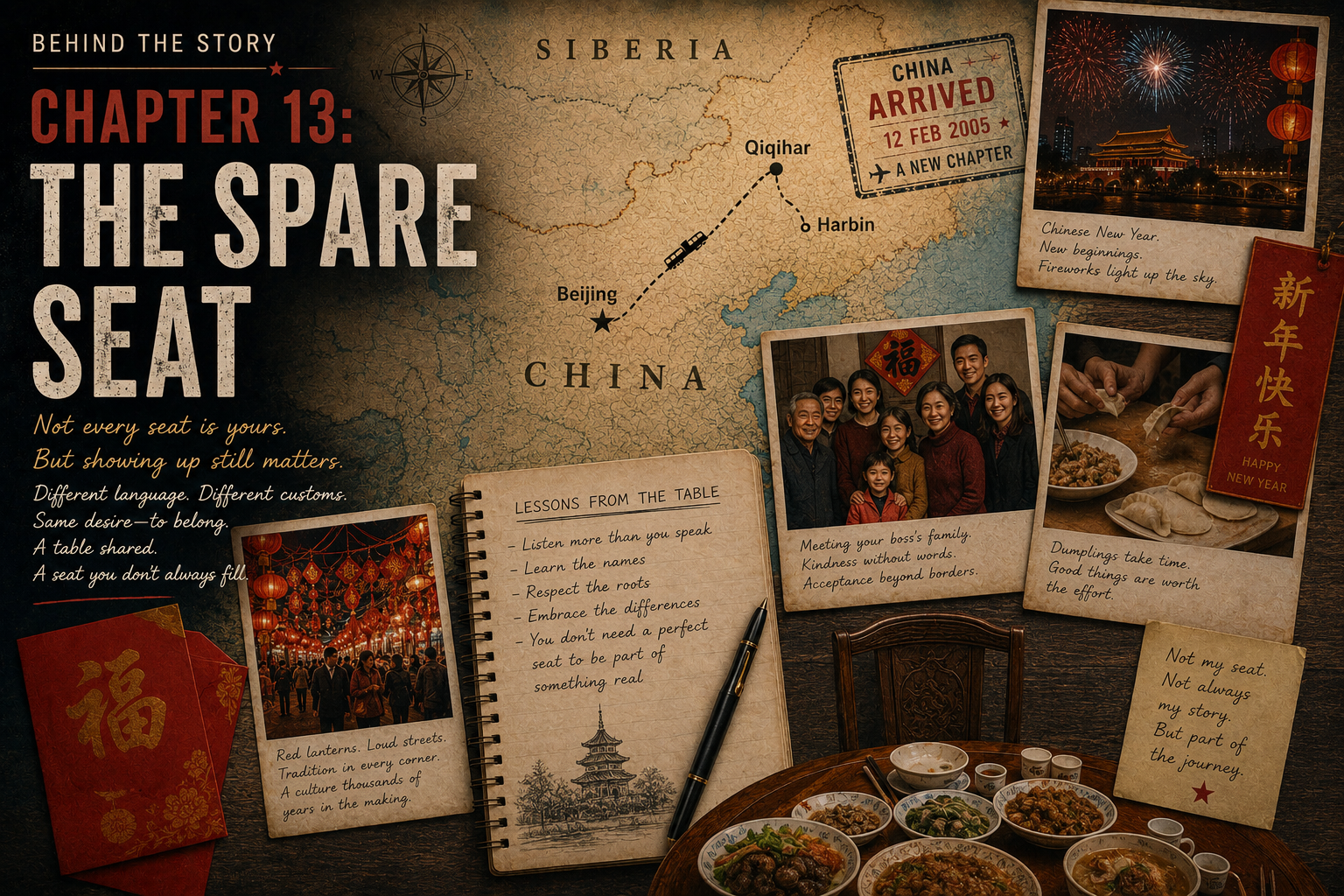
Qiqihar, China February 2010
The Chapter
After being let go from Netflix, Darren finds himself in Qiqihar, a city near the Siberian border and a world away from the Hollywood life he'd once been trying to build. He's there because Mr. Yao, his potential new boss, has invited him to spend Chinese New Year with his family — before either of them has seriously discussed the job at all.
What follows is nothing like a job interview.
Instead of conference rooms and business plans, Darren finds himself making dumplings, eating Dongbei barbecue, watching fireworks that never quite stop, and communicating across a language barrier that somehow doesn't seem to matter much. Mr. Yao's family doesn't simply welcome him as a guest — they gradually make space for him, as though his presence at the table were the most natural thing in the world.
Then, on New Year's Eve, Darren notices an extra place setting. A bowl. A pair of chopsticks. An empty chair.
He asks who it's for. The answer changes the way he sees the entire week.
Chapter Thirteen is about the difference between being welcomed somewhere and actually feeling like you belong. Sometimes all it takes is an empty chair, and someone willing to tell you it's yours.
Behind The Story
The Job Interview That Wasn't
I'd flown to Qiqihar expecting to talk about a job. Mr. Yao had other plans. He picked me up from the airport, took me home, introduced me to his family, and then spent the next week doing almost anything except discussing the position I'd actually come to China to fill. Every time I tried to steer things toward work, he redirected me toward food. Eat first. Business later. Eventually I stopped trying, which I've since decided was probably the entire point.
I later learned there's a word for what I was watching: guanxi, roughly relationship or connection, though that translation undersells it — it functions less like a phrase and more like a currency, one that has to be earned slowly, meal by meal, before either side considers there's anything worth putting on paper. I'd spent most of my professional life assuming relationships were something that happened around the work. Mr. Yao was showing me a completely different order of operations. The relationship came first. The business, if it came at all, could wait as long as it needed to.
A Family That Didn't Speak My Language
I couldn't have a conventional conversation with Mrs. Yao. Her English was limited, my Mandarin didn't exist, and I never once felt unable to communicate with her anyway. She communicated through food — a bowl that was never allowed to sit empty, the best piece of lamb quietly redirected onto my plate, a second helping arriving before I'd realized I'd finished the first. Her hospitality didn't require translation.
The twin boys were easier. Their argument over whose dumpling was better required no Mandarin at all — it was the exact same sibling rivalry I'd grown up with, just happening around a different kitchen table, in a different language, with the same total conviction on both sides. For the first time that week, China stopped feeling completely foreign.
The Spare Seat
The moment I remember most clearly wasn't the fireworks, or the food, or even the twenty-below cold. It was the empty chair.
On New Year's Eve, I noticed the extra place setting and asked Mr. Yao who it was for. Family who couldn't come home, he told me — some years, his mother; this year, nobody in particular, but they set it anyway, in case. Then he looked at me and said, "Sit. Tonight, is your chair too."
I'd known these people six days. They made room for me anyway. That's the part I still think about.
What I Know Now
Chapter Twelve ended with the best thing Netflix ever did for me being letting me go. I didn't know it yet, sitting in that layoff, that the very next chapter of my life would open with someone else doing the opposite — making room for me at a table I had no history with and no real claim to.
At the time, I thought I was learning something about Chinese culture. Looking back, I think I was learning something more personal. I'd spent years believing belonging was something you built slowly — earned through shared history, familiarity, language, or blood. Then I walked into a stranger's home during the one week of the year built entirely around going home to family, and experienced a version of belonging that seemed to require none of those things at all.
I didn't speak the language. I wasn't part of the family. I hadn't earned a place there through years of friendship. Someone simply made room.
That seems almost too simple to be a lesson, until you notice how rarely anyone actually does it. I'd already learned, a chapter or two earlier, what a table for one felt like — a life that looks full from the outside and isn't. Qiqihar didn't erase that feeling. It just proved the opposite of it existed too, and that it could show up from the most unlikely direction imaginable: a boss I'd known a week, a family who'd never met me before that flight, a chair built to hold someone else's absence that somehow had room in it for mine as well.
I've sat at plenty of tables since I belonged because I'd earned my place there. This one was different. For one night, I belonged because someone simply decided I did.
I still don't know exactly what to call that. I only know it wasn't business.