Behind the Story: Chapter 14 — The Outsider
What if you don't have to understand a place to belong to it?
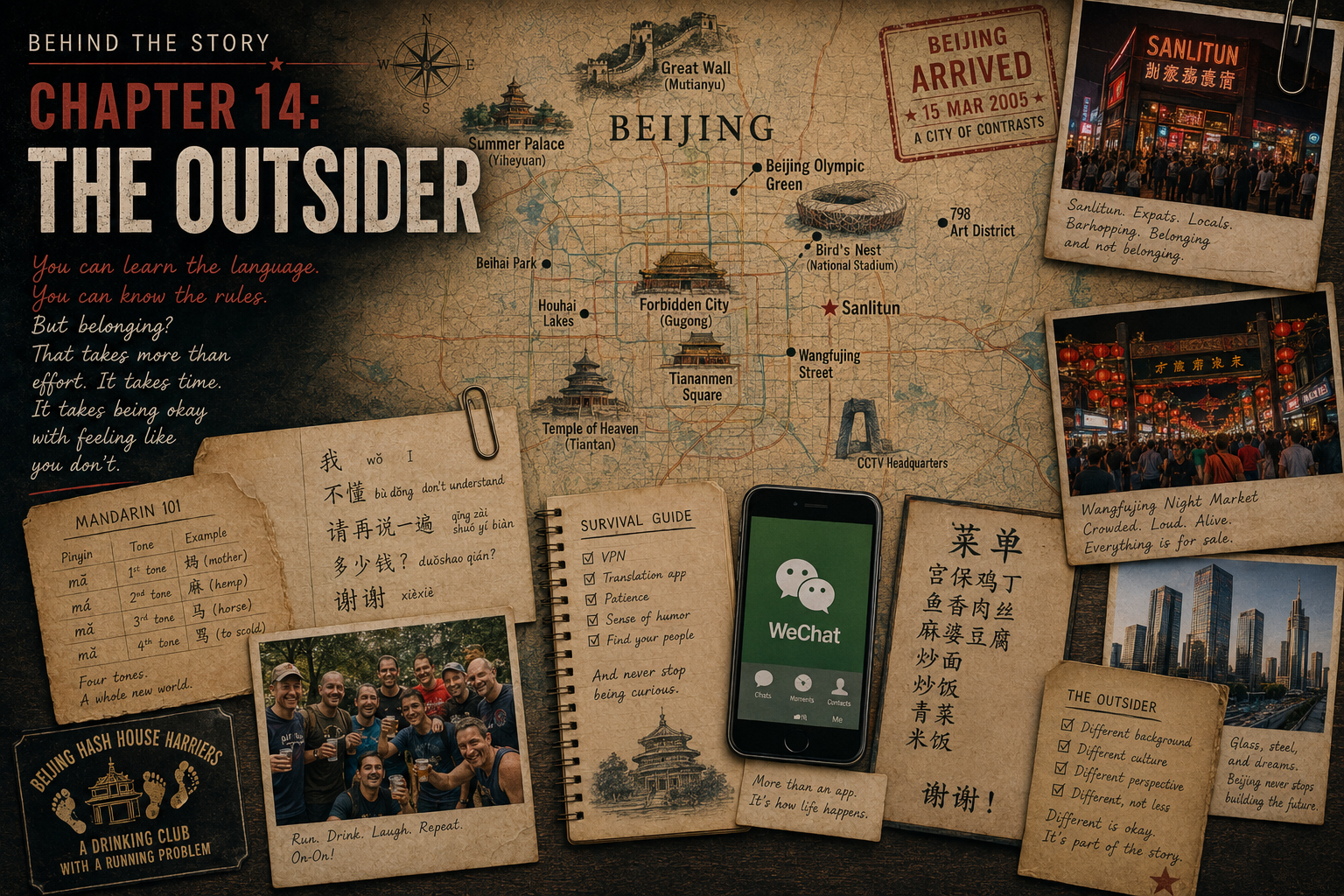
The Chapter
Chapter Fourteen takes Darren deeper into Beijing—and, unexpectedly, deeper into the question of what it actually means to belong somewhere.
He arrives in a city changing faster than he can understand it, where entire neighborhoods disappear beneath new roads and skyscrapers and the skyline seems to reinvent itself every time he looks away. Through Summer, Alex, the Hash House Harriers, WeChat groups, late nights in Sanlitun, and an alarming number of meals ordered by simply pointing at a menu, Darren slowly begins building a life.
There’s just one problem: he never learns the language.
For years, Darren assumes that being a local requires understanding the place you're living in. Beijing gradually proves him wrong. Somewhere between friendships, food, running clubs, and five years of showing up, the city stops feeling like somewhere he's visiting—even though he remains, in almost every conventional sense, an outsider.
Chapter Fourteen is about the strange space between being foreign and feeling at home—and the possibility that belonging has less to do with understanding a place than with finding people who make it yours.
You can learn the language. You can learn the rules. But sometimes belonging begins when you stop waiting to feel like you belong.
BEHIND THE STORY
I Never Learned Chinese
I lived in Beijing for five years and never learned a single Chinese character. I want that sitting there plainly before I explain anything else, because it's not a modest understatement—it's close to the entire premise of this chapter.
I actually tried, and more seriously than the chapter has room to admit. I enrolled at Beijing Language and Culture University, with formal classes, an actual student ID, and everything. My classmates were almost entirely in their early twenties, mostly Korean and Japanese, and I was the only Westerner in the room.
They picked up the language in what felt like weeks.
I did not.
Every night I'd go home and work through the pinyin, the tone, and the meaning—three separate things stacked on top of each other before a single word actually meant anything. I made a conscious decision early on not to bother learning the actual characters at all. Three things to learn for one word felt survivable. Four felt like a losing bet I wasn't willing to make.
Then I'd go out onto the street the next day and try what I'd learned the night before, only to get, almost without exception, a flat, polite “tīng bù dǒng”—I don't understand—from whoever I'd just tried it on.
The class moved fast enough that I was permanently behind, still trying to catch up on last week's vocabulary while this week's arrived on top of it, uncaught.
I dropped out by the second month.
Something did take hold, in the loosest possible sense of the phrase. I used to tell people I spoke survival Mandarin, which is a generous way of describing exactly enough vocabulary to get yourself home drunk in a taxi and not much else.
It was in that gap—formally enrolled, seriously trying, still fundamentally unable to read a menu—that the pig's feet arrived one night at a noodle place near my apartment, ordered entirely by pointing at a line of characters with more confidence than any of it warranted.
I ate them anyway, on principle.
I'd always assumed understanding had to come before belonging—that you don't get to feel at home somewhere until you've earned it through comprehension, the way you don't get a diploma until you've passed the exam.
Beijing taught me something considerably stranger.
Sometimes belonging shows up first, uninvited, while you're still stuck two months behind in a language class you already know you're about to fail.
What I Know Now
For years, I'd assumed understanding was the entrance fee for belonging.
Learn the language. Understand the culture. Figure out the rules. Then, once you've earned your place, you can finally call somewhere home.
Beijing dismantled that theory without ever asking permission.
I lived there for five years and never learned to read a Chinese character. I never became fluent. There were still entire conversations happening around me that I couldn't follow, signs I couldn't read, and pieces of the culture I knew I'd never fully understand.
And yet, somewhere along the way, I stopped being someone who was waiting to leave.
I think that's when I finally understood the difference between being an outsider and being alone. I could be a foreigner in Beijing forever and still have friends who knew me, a restaurant that knew my order, a neighborhood that felt familiar, and a life that would notice if I wasn't there.
I'd spent much of my life looking for places where I could finally fit.
Beijing taught me something different: maybe belonging isn't about fitting in at all. Maybe it's simply finding somewhere that makes room for you—and staying long enough to realize you've made a life there.
I never learned Chinese.
I never stopped being an outsider.
Beijing just stopped feeling like somewhere I was waiting to leave.
The Album 2010-2012