Part 4- The Beta Reader Experiment
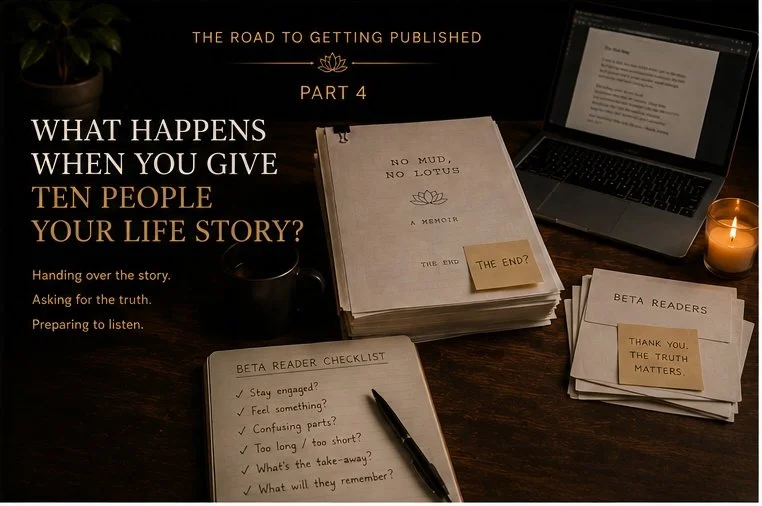
What happens when you hand ten people the most personal story you've ever written — and ask them to tell you the truth?
I didn't set out to find ten beta readers. I set out to find five, maybe eight, and see what happened.
I posted about it publicly — a long, honest Facebook post admitting that writing the book had been one of the hardest, most rewarding things I'd ever done, and that more than once I'd questioned whether I was brave enough to finish it. I asked for a diverse pool of readers: people who'd traveled the world, people who'd barely left home, people of strong faith, people who approached faith with skepticism, people who'd never met me at all. I said plainly that I wasn't looking for praise. I was looking for the truth.
The post got sixty likes and twenty-five comments, and more interest than I expected. Friends recommended other friends. One reader's daughter saw the post, messaged me, and asked if her mother could read it too. That mother has since become one of the most generous readers I've had — and just last week, she asked if she could pass the manuscript to a friend of hers, a school librarian. The circle keeps widening the same way it started: one person telling another person about a story that meant something to them.
I didn't spend much time thinking about what it actually meant to hit send on those emails. If I had, I'm not sure I would have done it. I might have decided to publish under a pen name instead. That's honestly still on the table. I'm writing this under my own name, and I still don't fully know how I feel about that.
Once the manuscript was actually out there, the fear showed up in a shape I didn't expect. Part of it was small and ugly and familiar — the same voice that's talked me into self-pity before, whispering that no one would respond, that maybe none of it meant anything, that maybe I didn't matter as much as I'd let myself believe while writing it. I know exactly where that voice comes from, and I don't trust it.
The real fear was different. It was realizing people were actually reading it. And not just reading it — responding to it emotionally, the way you'd respond to something that actually happened to someone you know. I've described this feeling before as being on a therapist's couch with a live feed running to an audience I can't see. That's exactly what this was. There was nowhere left to hide. People were going to see the real me, and I couldn't take any of it back once it was out.
The book itself has quietly become part of my own transformation — not just the writing of it, but this part too, the part where other people finally get to hold it.
What actually surprised me wasn't the fear. It was the specificity.
I expected feedback to be kind but general — "I liked it," "it was moving," that kind of thing. Instead, readers started quoting entire sentences and paragraphs back to me, scenes I'd half-forgotten writing, lines I didn't know had landed until someone else repeated them to me in their own words. That's a different kind of compliment than "I liked your book." That's someone telling you a piece of your own writing is now living somewhere inside their head.
Linda, my high school journalism teacher decades ago, gave me maybe the best indirect compliment I've received through this whole process. Somewhere around Chapter Twelve, she told me she was struggling — not with the book, but with the task I'd given her. She wanted to keep reading straight through without stopping to take notes. The story itself kept pulling her past the job of being a beta reader. When she finally finished the whole manuscript, her reaction was immediate:
"Profound and deeply moving. I can't stop thinking about the power of your words, and I want to read them again and again."
She told me the ending paid off completely — that it left her with hope, the specific kind that comes from watching someone stop running and finally face the truth. She also told me a story of her own, about her grandmother's bagel recipe, and how she still brings a small batch to her parents' graves. I hadn't expected that a book about my life would hand someone else a way back into a memory of their own. That might be the whole point of writing any of this down.
The real test hasn't happened yet. Most of my readers are still working through the manuscript, and I expect the feedback won't all be flattering. That's the point. Making something this personal public means eventually hearing from people who don't connect with it, or who see something I didn't intend, or who just don't like it. I don't get to choose where it lands once it's out there — I only got to choose whether to send it in the first place.
Your reactions are becoming part of the story of how this book gets finished, and I'll be sharing what I'm learning along the way.