Part 3- Why I Finally Decided to Write This Book
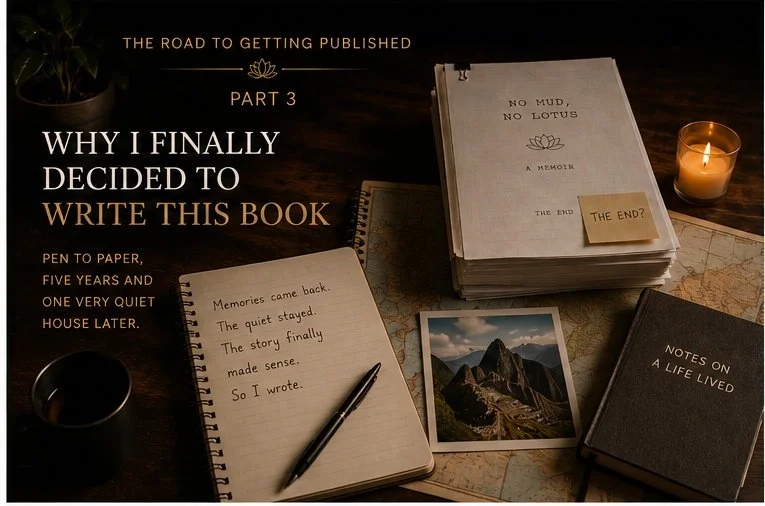
Pen to paper, five years and one very quiet house later.
I didn't sit down one day and decide to write a memoir. If anything, the book decided it was time, and I was just the last person to find out.
For most of my life I thought I was simply collecting things — places, people, mistakes, stories worth telling at a dinner table years later. I didn't realize there was a single thread running underneath all of it until I was finally quiet enough to hear it.
I finally got quiet enough to hear it
The last five years hadn't been easy. Three years in Bellingham, two more in Portland, and Portland in particular was a genuine daily struggle — money was tight, and worse than that, I couldn't seem to make real friends. Loneliness has a way of dragging everything else down with it once it settles in. By late 2025, I knew I needed to be back around family, old friends, people who actually knew me, so I moved home to Houston.
The house I moved into afterward was quiet in a way I wasn't used to — the kind of quiet that comes with getting sober and choosing, deliberately, not to fill every evening with noise. I didn't feel like watching television. I didn't feel like doing much of anything, honestly, except that the memories had started coming back so vividly it was almost uncomfortable — like something that had been locked away for years and was suddenly, finally, allowed to get out. So I started writing.
I wrote for hours most nights. If a memory surfaced during the day, I'd leave whatever I was doing and go write it down before it faded. If something came back to me mid-meal, I'd be typing notes into my phone with one hand. It became a fixation — not a hobby, not a project, an obsession. I wrote the first draft in two weeks. Thirty-one chapters. Over eighty thousand words.
I wasn't racing against forgetting what happened. I was racing against something less certain — the fact that sobriety has never been a place I get to stay permanently. I understood, even writing it, that the clarity I had in that moment wasn't guaranteed to still be there later. I needed to get it all down while I still had it.
The story had been accumulating for years — I just hadn't recognized it yet
This wasn't actually my first attempt at something like this. It was just the first one that worked.
One of my favorite books has always been Michael Crichton's Travels — his own life on the road, his observations, the history folded into the stories. That book had been the model sitting in the back of my head for years. I just hadn't realized I'd already started collecting the raw material for my own version: a travel diary from a semester abroad in London, mass emails sent home to friends and family back in 2004, before anyone had a blog or a personal website. Those old emails in particular became the real skeleton for several early chapters — specific details I could never have reconstructed from memory alone, twenty years later, without something written down at the time.
I want to be honest about something else, too: this isn't a complete, unbroken timeline of my life. There are real gaps — years that simply aren't in the book, because they didn't belong to the story I was actually trying to tell. I followed the thread that mattered, not the calendar.
Peru made me understand what the story was actually about
The book's last chapter takes place in Peru, in November of 2023. That trip is where something in me finally cracked open enough to look directly at twenty years of choices instead of around them. I'd gotten tired — tired of being lonely, tired of being unhappy, tired of assuming the next place or the next version of myself might finally be the one that fixed it. Peru is where I stopped outrunning that question and just sat with it. That's the actual origin of this book, even though the story itself spans two decades before I ever set foot there.
Writing it meant finally allowing myself to be seen
Once the book existed, a different fear showed up — not the fear of starting, the fear of finishing. People seeing the actual me. I'm fairly transparent in this story, and transparency invites judgment right alongside understanding. It's an odd, specific kind of exposed — like being on a therapist's couch with a live feed running to an audience you can't see.
But somewhere in writing it, I got more tired of hiding than I was afraid of being seen. I had to stop managing the version of myself other people were getting, and just tell the truth instead. I don't think what I went through is unique to me. I think most people are asking some version of the same question underneath their own lives: am I running toward something, or running away from something? I just happened to write mine down.
Chapter One opens on a box of pencils that needed three signatures to order. On the surface, it's almost funny — a small, bureaucratic absurdity. But it was never really about pencils. It was the moment I noticed I'd built my entire adult life inside a system designed to make sure I never had to decide anything important on my own — and that I'd been asking permission for things that were never actually anyone else's to grant in the first place.
That's the real reason this book exists. Not because I collected enough stories to fill a manuscript. Because I finally got quiet enough, and honest enough, to understand what all of them were actually about.