My Father Bet on Options and Crocodiles:
Life in the 1980’s
Risk, money, movies, and the stories we inherit.
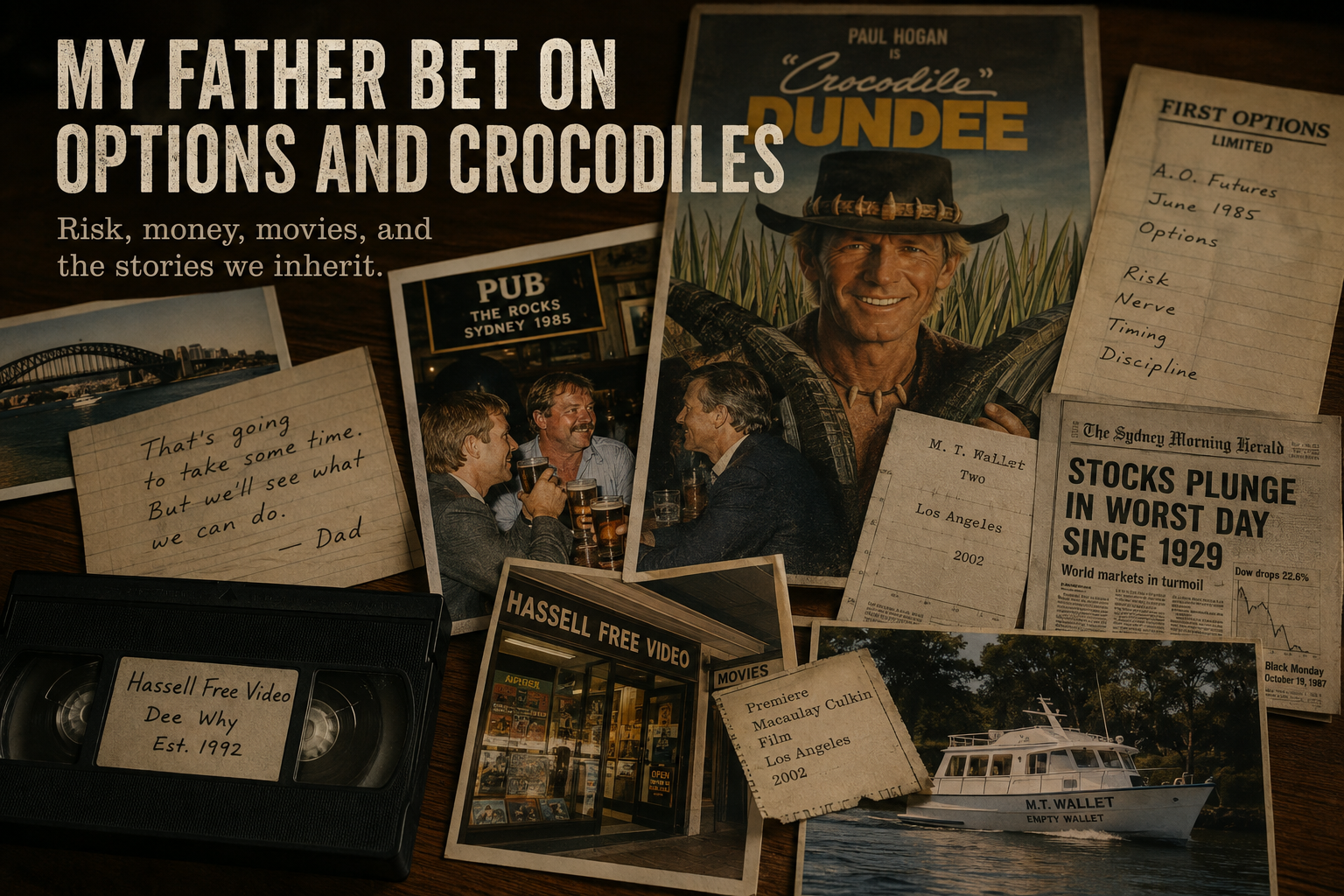
Every family has a story about the one time it brushed up against something bigger than itself. Mine begins in a pub near The Rocks in Sydney, sometime in the middle of 1985, with two men, a few pints, and a movie nobody yet knew was going to become an international phenomenon.
My father, Lee, was a stockbroker, which is a profession built almost entirely around confidently discussing sums of money he did not personally possess. He was having a pint with a friend of his, a man everyone called DJ, when two other men walked in looking like their dog had just died.
DJ recognized one of them immediately.
"What's got you down, Hoagie?"
"Don't want to talk about it, mate."
"Can't be that bad. I'll buy you a round."
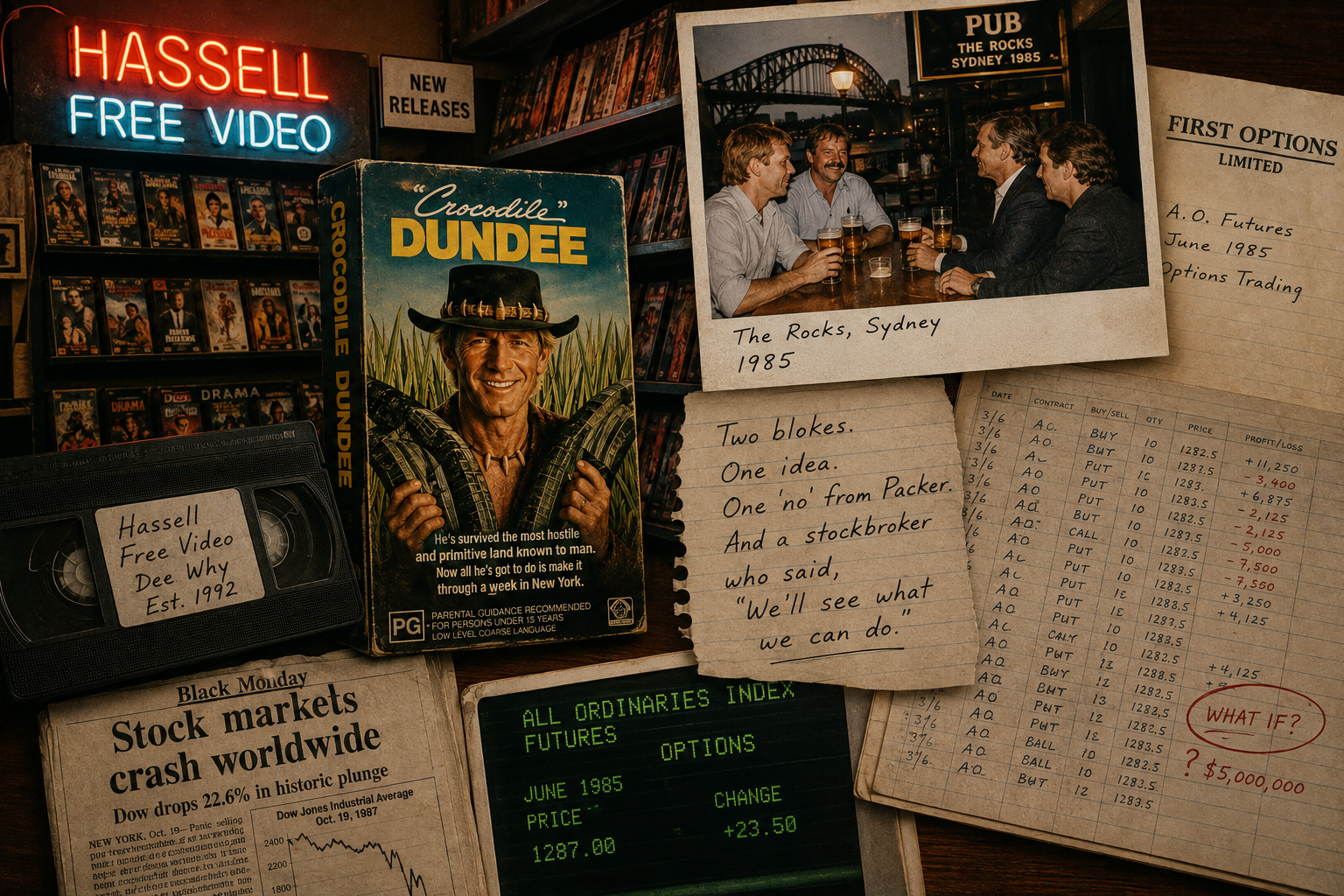
The man shook his head. "Got this idea for a film. Just pitched it to Packer."
He let that sit there for a second, the way you let a bad piece of news finish landing before you say the rest of it out loud.
"And that bastard turned us down."
My father didn't know, at the time, that he was sitting across from Paul Hogan and John Cornell, or that the man who'd just passed on their pitch was Kerry Packer, one of the most powerful businessmen in Australia. He just knew two men needed money for something, and he was, professionally speaking, in the business of finding money for things.
"How much do you need?"
"About eight million."
I like to imagine there was a pause here, the kind any reasonable person takes before agreeing to help raise eight million dollars for a movie about a crocodile hunter pitched to them by a stranger in a pub. If there was, family legend has never included it. What family legend has always included is my father's reply, delivered with the specific, unearned confidence stockbrokers seem to be issued at birth.
"That's going to take some time. But we'll see what we can do."
To understand why my father was even in a position to say yes to something like that, you have to understand what he'd spent the previous decade building. The Sydney Stock Exchange had established Australia's options market in February 1976, making Australia the first marketplace outside North America to trade exchange-listed options. The country wasn't simply following someone else's lead; it was experimenting in real time with a financial product that was still relatively new.
For its first several years, the market only handled call options. Puts weren't introduced until 1982, expanding what a trader with the right nerve could actually do with the instrument.
My father was there for essentially all of it, front row, eventually running his own trading company, First Options Limited. Australia's financial system was changing fast underneath him. Major deregulation of the securities industry came in 1984. The All Ordinaries share price index futures contract had begun trading in 1983, and options on that futures contract launched in June 1985 — the same year, as it happens, that two men he'd never met walked into a pub with a movie idea nobody else wanted to fund.
In the 1980s, he was building a business around Australia's options market while helping finance a small Australian film at the same time. One involved financial derivatives. The other involved a man with a very large knife. Somehow, both worked out.
Not everything did, though, and the one that didn't is the story he tells with considerably less pride, usually only after a few drinks.
He'd become something close to a fortune-teller about the market by then — he was convinced it was overvalued, that a serious correction was coming, that it wasn't a matter of if but when. So he shorted it. Week after week, building the position, watching it not pay off yet, adding to it anyway, until he was in for somewhere between fifty and a hundred thousand dollars, which in the mid-1980s was not a number a person absorbed easily if they were wrong. He needed the market to break. He just needed a little more time than he had.
He closed the position one week before it would have paid off. The crash came on October 19, 1987 — Black Monday, the Dow falling 22.6 percent in a single day, still the largest one-day percentage decline in its history. Had he held for seven more days, by his own account, he'd have netted more than five million dollars.
I think about that week often. Not because I need the money now, or even because I particularly needed it growing up, but because it's the kind of detail that quietly reorganizes how you think about your own life — one week, and an entire different childhood might have been sitting on the other side of it. It wasn't really a mistake, the way he tells it. It was a regret, which is a different and worse category of thing to carry, because a mistake at least teaches you something specific. A regret just sits there, unfinished, refusing to resolve into a lesson. It's the same shape, oddly, as my own two-million-dollar regret with Netflix stock — a story that gets its own chapter elsewhere in this book. Different decade, different market, same particular flavor of if only I'd waited one more week. We aren't allowed to play the what-if game, not really. Hindsight doesn't care how good it is at its job.
None of this means I grew up hard done by. I grew up, by any honest measure, with a silver spoon — even if my father hadn't started making real money until he was well into his forties, and even if the version of wealthy I experienced was mostly downstream of decisions he'd made about a market most twelve-year-olds have never heard of. I attended Sydney Grammar School from kindergarten straight through. My brother Jason and I had, by any reasonable measure, the best education money could buy.
I've come to think that's not quite the unambiguous gift it sounds like on paper. Being smart, in my experience, doesn't reliably translate into being able to grow — sometimes it just gives you a more articulate set of reasons for staying exactly where you are.
I rarely saw my father during the week. Weekends were different — we sailed, all of us, on a forty-six-foot cabin cruiser he'd named, with the specific self-deprecating humor I'd later recognize as entirely his, M.T. Wallet. Empty Wallet. We spent most of my childhood birthdays out on the Hawkesbury River basin north of Sydney, on a boat named after the exact thing it had cost him to buy it.
By the early nineties he was doing well enough to have minted a handful of millionaires inside his own company, and well enough to have some money left over for the specific brand of restlessness that seems to run through this family regardless of which generation is carrying it. He opened a café in Dee Why. My mother, meanwhile, was bored at home, and the one thing she genuinely loved was the movies, so he built her a company around it.
We opened a video rental store from the ground up. A distributor pulled a station wagon up to the curb, packed floor to ceiling with VHS cassettes, and my mother and I stood there picking through it, hand-selecting the roughly three thousand titles that would eventually fill the shelves. She called it Hassell Free Video. Most afternoons after school I'd get off the train and walk straight there, fish and chips in hand, and watch whatever was playing while my mother ran the place like it was the job she'd been waiting her whole life to be given. That's the actual origin of my love of film, if I'm honest about it — not some later, more mature discovery. A video store in Dee Why, and a mother who was finally, visibly happy at work.
It's not a coincidence I ended up majoring in film at TCU. The thread was already laid down years before I ever filled out an application.
In November of 2002, my mother found a lump during a routine exam. She underwent a double mastectomy followed by aggressive chemotherapy. Once she'd recovered enough to travel, I flew her out to Los Angeles, mostly because I wanted her to see the life I was building out there — I wanted, plainly, to make her proud. Through a stroke of luck I'd never fully explain, I ended up with tickets to a red-carpet premiere for a Macaulay Culkin film, and we walked that carpet together, my mother in remission and dressed for the occasion, both of us aware without saying so that this particular ordinary-extraordinary night was not something either of us had been guaranteed a year earlier.
My love for film never actually left after that, even once the practical version of a film career mostly did. I optioned the screenplay rights to a project on JFK at one point, wrote my own script, and shopped it around Hollywood the way you shop anything around Hollywood — persistently, and ultimately without a sale. It joined the long, unglamorous list of things that almost happened.
Then, in the fall of 2025, my Uncle Eddy asked me to help produce and distribute his award-winning documentary, Reflections of Courage. I said yes before I'd fully thought through how long it had actually been — over twenty years out of the industry, most of my old contacts gone cold, half the landscape rebuilt since I'd last had a working relationship with any of it. It didn't matter. Some part of me had apparently been waiting for exactly that kind of ask the entire time.
I've started giving real thought, since then, to adapting my family's Holocaust story into a feature film of its own — the Boas family, the Lost Train, the pieces of history this book has already spent a chapter trying to hold. I don't know yet if that's a real project or just the newest version of an old restlessness wearing a more meaningful costume. But I've learned by now not to be too quick to tell the difference. My father heard a story in a pub once and decided, with no film experience and no good reason, that it was worth backing. I've been doing some version of that same thing, apparently, since I was old enough to pick VHS tapes off the back of a station wagon.
Darren’s Childhood Memories